China High-Speed Rail Advertising 2025: The World's Largest Transit Media Network
China operates the world's largest high-speed rail (HSR) network with over 42,000 kilometers of track, 4,000+ high-speed stations, and annual ridership exceeding 3.8 billion passenger journeys. This unprecedented infrastructure creates an advertising ecosystem of unparalleled scale and audience quality.
What High-Speed Rail Advertising Formats Are Available?
China's HSR advertising ecosystem spans both on-train and station environments:
On-Train Formats
- Train Naming Rights — Exclusive branding rights to a specific CRH/Fuxing train set. From ¥1,500,000/year. The train's exterior, interior, and passenger documentation carry your brand identity.
- Train Body Advertising — Partial or full exterior vinyl wrap on high-speed train bodies. From ¥1,000,000/year. Visible to millions at 350+ stations.
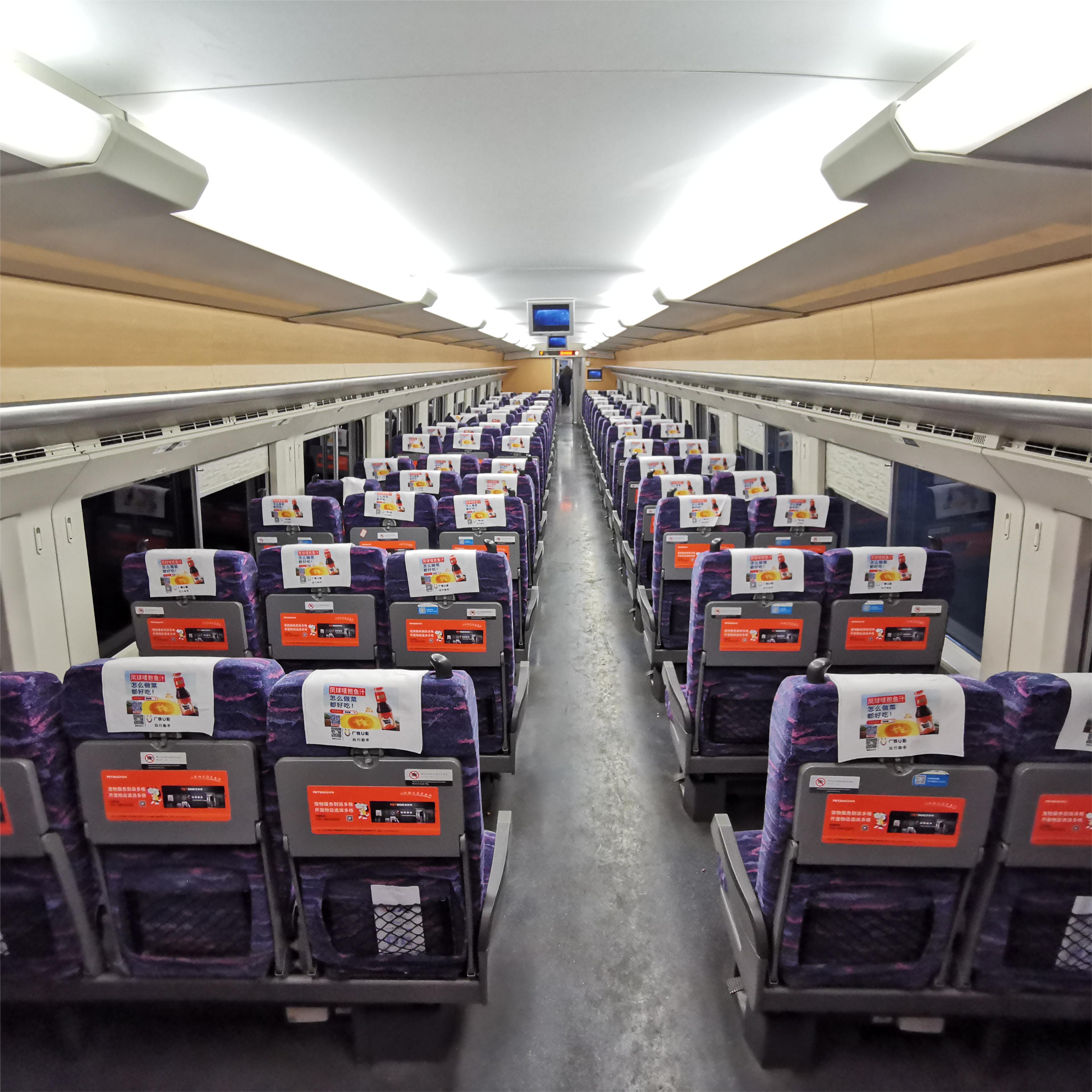
- Headrest Cover Advertising — Branded pillow covers on every seat, changed per journey. High-frequency, close-proximity exposure.
- Tray Table Advertising — Full-surface brand panels on fold-down tray tables. ¥50,000/month per train.
- Seat Advertising — Back-of-seat brand panels or digital screens in select trains.
In-Station Formats
- Digital Screen Networks — LED and LCD digital displays throughout station concourses, platforms, and retail areas.
- Large LED Walls — Mega-format outdoor LED screens at station entrances and main halls. Available at 300+ cities nationwide.
- Platform Lightboxes — Sequential lightbox displays along platforms creating a "tunnel effect" as trains depart.
- Chengdu Railway Bureau Network — Comprehensive media portfolio covering all stations within Chengdu Railway Bureau jurisdiction (western China's largest rail region).
China HSR Advertising Pricing Guide 2025
| Format | Price Range | Unit |
|---|---|---|
| Train Naming Rights | ¥1,500,000 | per year |
| Train Body Wrap | ¥1,000,000+ | per year |
| Tray Table Ads | ¥50,000 | per train/month |
| Headrest Cover Ads | Quoted on request | per train/month |
| Station Digital Screens (300 cities) | 30% discount packages available | per campaign |
| Guangzhou South Station LED | Custom | per week |
| Shenzhen HSR Station Package | Custom | per week |
Key HSR Corridors for Advertising Investment
The highest-value advertising corridors based on passenger volume and demographic quality:
- Beijing–Shanghai Corridor — 350 km/h, 4.5 hours, 300,000+ daily passengers. Highest business traveler concentration in China.
- Guangzhou–Shenzhen–Hong Kong Corridor — Key Pearl River Delta business route connecting mainland China to Hong Kong SAR.
- Chengdu–Chongqing Corridor — Western China's fastest-growing business route, gateway to Sichuan-Chongqing Economic Circle.
- Beijing–Guangzhou Corridor — 2,298 km north-south backbone, passes through 35 major cities.
- Shanghai–Kunming Corridor — Key route connecting Yangtze River Delta to Southwest China and ASEAN border regions.
Frequently Asked Questions: China HSR Advertising
Q: What is the demographic profile of China high-speed rail passengers?
A: China Railway's passenger survey data shows: 62% are aged 20–45, 54% are professionals or managers, average income is ¥8,000–¥15,000 per month, 73% are travelling for business or education purposes on weekdays. Weekend passengers skew younger (18–35) and are predominantly leisure/tourism travelers. Overall, HSR passengers represent China's growing middle class and upper-middle class — the primary target for consumer brands, financial services, real estate, and technology products.
Q: How does China high-speed rail advertising compare to subway advertising?
A: HSR advertising targets a more affluent, geographically mobile audience than city subway systems. Average journey time on HSR is 2–4 hours (vs. 20–40 minutes on subway), providing substantially longer brand exposure. HSR passengers also have higher average incomes and are more likely to be making high-value purchase decisions (property, automobiles, business services). Subway advertising offers greater frequency for urban residents; HSR offers deeper engagement and premium audience demographics.
Q: What is train naming rights advertising in China?
A: Train naming rights allows a brand to "adopt" a specific high-speed train set, which then travels branded with the company's identity on designated routes. The train's exterior livery, interior branding panels, seat headrests, and staff uniforms may carry the brand. This format generates significant earned media coverage and social sharing as passengers photograph and post about branded trains. It is particularly effective for automotive, luxury goods, technology, and financial services brands seeking strong brand association with China's modern infrastructure.
Q: Can I advertise across multiple HSR stations simultaneously in China?
A: Yes. Network packages covering 300 cities simultaneously are available at significant discounts (typically 30–50% below individual station rates). These packages are managed through authorized media operators who hold concession agreements with China Railway Group (中国铁路). A single campaign brief can be activated across the entire national network with unified creative and reporting.
Access China's high-speed rail advertising network across 300 cities. Get a custom quote from GameVod Media.